


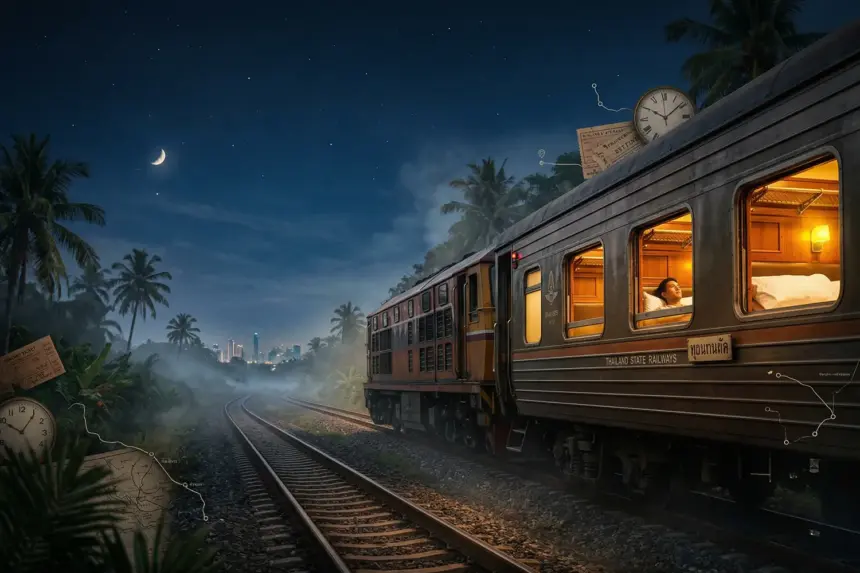
Bangkok Sleeper Train Guide: The Art of the Overnight Journey
For many, the overnight train from Bangkok to the north or south is more than just a transit option—it is a rite of passage. While budget airlines offer 70-minute leaps across the kingdom, the sleeper train provides a slow-motion transition through the Thai landscape that no flight can replicate.
- The New Hub: Krung Thep Aphiwat Central Terminal
- Choosing Your Carriage: CNR vs. Traditional
- Understanding the Class System
- How to Book Tickets in 2026
- Life on Board: Food, Water, and Sleep
- Top Routes and Timings
- Frequently Asked Questions
- Is the sleeper train safe for solo female travelers?
- Can I buy tickets at the station on the day of travel?
- Is there Wi-Fi on the train?
- What happens if the train is late?
- Where do I store my luggage?
- Final Thoughts
The experience has changed significantly in recent years. The shift from the charming but aging Hua Lamphong to the gargantuan Krung Thep Aphiwat Central Terminal was more than just a change of scenery; it modernized the logistics of Thai rail travel while leaving some of the old-world nostalgia behind on the platforms of the old city.
This guide covers everything you need to know about navigating the Thai sleeper system in 2026, from securing the coveted CNR (Chinese-built) carriages to the logistics of getting a decent meal at 40 mph.
The New Hub: Krung Thep Aphiwat Central Terminal
Krung Thep Aphiwat Central Terminal (often still referred to by locals as Bang Sue Grand Station) is the massive, modern starting point for almost all long-distance sleeper services.
If you are following outdated blogs telling you to go to Hua Lamphong, you will miss your train. Hua Lamphong now primarily serves local commuter lines and special excursion trains.
Navigating the Terminal
The scale of Krung Thep Aphiwat can be intimidating. To reach it, take the MRT Blue Line to Bang Sue Station. From there, underground walkways lead directly into the terminal.
- Arrival Time: Aim to arrive at least 45 minutes before departure. The platforms are long, and the walk from the ticket counter to the boarding gate can take 10 minutes.
- Gate System: Much like an airport, you wait in a central concourse until your gate (based on your destination) opens about 20–30 minutes before departure.
Choosing Your Carriage: CNR vs. Traditional
The State Railway of Thailand (SRT) operates two distinct types of sleeper carriages. Your choice here defines your comfort level.
1. The “New” CNR Trains (Special Express)
Introduced around 2016, these Chinese-built trains (officially designated as Trains #9/10 to Chiang Mai, #31/32 to Hat Yai, and #25/26 to Nong Khai) are the gold standard.
- Features: Vacuum toilets (much cleaner), touch-screen infotainment (mostly for route tracking), and power sockets at every seat.
- Climate: The air conditioning is notoriously aggressive. It is set to “arctic” and rarely fluctuates. Bring a hoodie.
- Safety: These trains feature CCTV and are generally considered very safe for solo female travelers.
2. The Traditional Sleeper (Express & Rapid)
These are the older, purple-and-gold carriages. They lack the high-tech finish but offer a more “classic” feel.
- Vibe: Expect some rattling and slightly older upholstery.
- Windows: On older “Rapid” trains, you might still find fan-cooled sleepers where windows can be opened—perfect for photographers, but expect to be covered in a fine layer of dust by morning.
Understanding the Class System
First Class (1st Class)
A private lockable cabin for two people.
- Pricing: Roughly 1,450–1,650 THB per person.
- The Perk: You get a private sink and a door. If you are traveling solo and don’t want to share, you have to pay a “single occupancy” supplement, which effectively costs nearly the price of two tickets.
- Shower: There is a shared hot shower at the end of the 1st class carriage.
Second Class (2nd Class AC Sleeper)
The most popular choice and, arguably, the most social.
- Pricing: Roughly 800–1,100 THB depending on the route and bunk.
- The Layout: During the day, you sit in wide, comfortable seats facing each other. Around 8:00 PM, the attendant magically transforms these seats into upper and lower bunks with fresh linens and privacy curtains.
- Pro Tip: Always book the Lower Bunk. It is wider, has its own window, and you don’t have to climb a ladder. It usually costs about 100 THB more than the upper bunk, but it is worth every satang.
How to Book Tickets in 2026
Tickets for popular routes like Bangkok to Chiang Mai sell out weeks in advance, especially during the cool season (November–February) and Songkran (April).
D-Ticket: The Official Way
The D-Ticket website (and mobile app) is the official portal.
- Booking Window: You can book up to 180 days in advance for long-distance routes if you are traveling more than 60% of the route.
- Payment: International credit cards are now widely accepted, though the system remains slightly temperamental.
- Print vs. Digital: While most conductors accept a PDF on your phone, the official rule still suggests having a printed copy. Most high-end hotels will do this for you.
12Go Asia: The Reliable Alternative
If the official site gives you a headache, 12Go Asia is the go-to agency. They charge a small service fee (usually around 100–200 THB) but their interface is flawless, and they physically go to the station to secure tickets the moment the window opens.
Life on Board: Food, Water, and Sleep
The Dining Car
On the newer CNR trains, the dining car is clean and modern but often serves pre-packaged, microwaved meals.
- Menu: Expect Basil Chicken (Pad Krapow) or Green Curry for around 120–180 THB.
- Alcohol: Since 2014, alcohol has been strictly banned on all SRT trains and platforms. Don’t try to sneak it on; the fines are heavy, and the rule is strictly enforced.
The “Attendant” Service
In 2nd class, an attendant will walk through and take orders for breakfast (usually eggs, toast, and coffee) which they deliver to your seat in the morning. It’s overpriced and mediocre, but drinking coffee while watching the mist rise over the mountains in Lampang is a core memory.
Survival Kit for the Night
- Earplugs/Eye Mask: The lights in the corridor stay on all night, and the curtains aren’t 100% blackout.
- Power Bank: While CNR trains have sockets, they can occasionally be loose or non-functional.
- Toiletries: Bring a small “overnight” bag. The bathrooms have soap, but no towels or showers (unless you’re in 1st class).
- Slip-on Shoes: You do not want to be tying laces every time you need the bathroom at 3:00 AM.
Top Routes and Timings
| Route | Train Number | Departure (BKK) | Arrival | Best Carriage |
| Bangkok to Chiang Mai | #9 (Special Express) | 18:40 | 07:15 | CNR (New) |
| Bangkok to Surat Thani | #31 (Special Express) | 14:50 | 01:23* | CNR (New) |
| Bangkok to Nong Khai | #25 (Special Express) | 20:25 | 06:25 | CNR (New) |
Note: Most travelers bound for Koh Samui or Koh Tao take the #85 or #167 which arrive closer to dawn for ferry connections.
Frequently Asked Questions
Is the sleeper train safe for solo female travelers?
Yes, it is remarkably safe. On the new CNR trains, there is a dedicated Ladies Only carriage. Even in the general 2nd class carriages, there is a constant presence of staff and CCTV.
Can I buy tickets at the station on the day of travel?
For 3rd class (seats only), yes. For sleepers, almost never. These routes are incredibly popular with both locals and tourists; booking at least 2–4 weeks in advance is highly recommended.
Is there Wi-Fi on the train?
No. While there have been pilot programs, do not count on it. 4G/5G coverage along the main tracks is generally excellent, except for a few tunnels and mountainous stretches in the north.
What happens if the train is late?
In Thailand, the question is usually how late. While the new CNR trains are more punctual, delays of 30–60 minutes are common. Do not book a tight flight connection immediately following a train arrival.
Where do I store my luggage?
In 2nd class, there are luggage racks at the end of the carriage and space under the lower berths. In 1st class, your bags stay in your cabin. Large suitcases are usually fine, but keep your valuables in a smaller bag next to your pillow.
Final Thoughts
The Thai sleeper train is a lesson in patience and perspective. It allows you to feel the geography of the country—the transition from the humid concrete of Bangkok to the limestone karsts of the south or the teak forests of the north. By choosing the right carriage and booking ahead, you turn a simple transfer into one of the most comfortable and culturally rich segments of your journey.